
Family Legacy Management: Why Succession Is Only One Piece of the Picture
Families around the world have long explored effective ways to protect their wealth, uphold shared values, and ensure the continuity of family businesses across generations. Over time, informal arrangements involving trustees and professional advisers have evolved into a more coordinated framework known as family office, which brings together wealth management, succession planning, family decision-making, and long-term strategic direction.
At the core of a family office is an integrated approach comprising several interconnected elements:
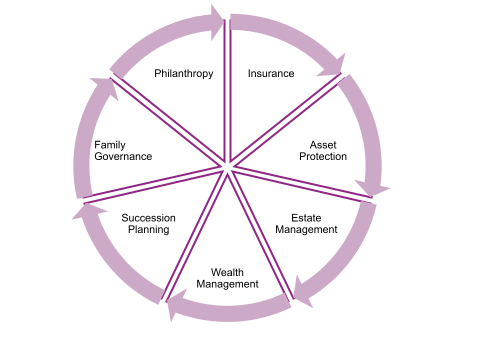
The family office framework may be understood as a continuous cycle rather than a series of separate functions. Each component is interconnected, and a change in one area may affect the family’s overall wealth, governance, and succession arrangements.
The cycle generally comprises the following seven components:
1. Insurance – Creating Protection and Liquidity
Insurance provides financial protection against unexpected events such as death, disability, illness, or business disruption. It may also create liquidity to meet estate liabilities, repay debts, support dependants, or facilitate the transfer of a family business without forcing the family to dispose of important assets.
2. Asset Protection – Safeguarding Family Wealth
Asset protection focuses on shielding family assets from potential business risks, personal liabilities, creditor claims, disputes, and other unforeseen circumstances. This may involve the appropriate use of companies, trusts, foundations, holding structures, and contractual arrangements.
3. Estate Management – Organizing the Transfer of Assets
Estate management ensures that assets are properly identified, documented, administered, and transferred according to the family’s intentions. It may include wills, trusts, foundations, beneficiary designations, powers of attorney, and arrangements for incapacity or death.
4. Wealth Management – Preserving and Growing Assets
Wealth management involves establishing an investment strategy that reflects the family’s financial objectives, risk tolerance, liquidity requirements, and investment horizon. It includes asset allocation, portfolio monitoring, cash-flow planning, tax considerations, and performance evaluation.
5. Succession Planning – Preparing the Next Generation
Succession planning addresses the transfer of ownership, leadership, responsibilities, and decision-making authority to the next generation. It also involves identifying suitable successors, developing their capabilities, and establishing a structured transition plan for the family business and other assets.
6. Family Governance – Establishing a Decision-Making Framework
Family governance provides a formal framework for communication, participation, and decision-making among family members. This may be documented through a family constitution, family council, shareholder agreement, succession policy, conflict-resolution mechanism, or other governance arrangements.
7. Philanthropy – Preserving the Family’s Values and Legacy
Philanthropy allows the family to express its shared values and create a positive social impact. Charitable initiatives may be organised through foundations, trusts, endowment funds, or structured giving programmes, with clear objectives and governance arrangements.
The family office framework is an ongoing cycle because no family remains unchanged. New family members may be born, relationships may evolve, businesses may expand or be sold, regulations may change, and the family’s financial priorities may shift over time. Each development can affect multiple areas of the framework. For example, a change in business ownership may require the family to revisit its succession plan, governance arrangements, estate documents, insurance coverage, and investment strategy.
For this reason, all seven components should be reviewed periodically to ensure that the family’s wealth, business interests, shared values, and long-term objectives remain aligned. If any component is overlooked, a weakness may only become apparent when the family faces a significant transition, dispute, incapacity, or loss.
In the coming weeks, we will explore the principal structures and planning tools that support this cycle, including:
- How holding companies and trusts can work together to organise family ownership, protect assets, and facilitate the orderly transfer of wealth across generations;
- How foundations can provide a structured framework for preserving and administering family wealth while supporting long-term succession and legacy objectives;
- How a corporate will, together with appropriate business continuity arrangements, can provide clear directions for the transfer and management of company shares and business interests following the death or incapacity of a business owner;
- How preparing a comprehensive record of family assets, liabilities, ownership structures, legal documents, and intended beneficiaries can identify structural gaps before succession planning begins;
- How a family constitution and family governance council can define roles, establish clear decision-making processes, manage disagreements, and maintain family unity;
- Why succession planning should prepare the next generation to assume ownership, responsibility, and leadership, rather than merely receive an inheritance; and
- How philanthropy can unite the family around a shared purpose and transform family wealth into a meaningful and enduring legacy.
The objective is not to introduce complexity unnecessarily. It is to create clarity around ownership, responsibilities, decision-making, and succession. An effective family office framework should ultimately provide protection and continuity while remaining grounded in trust, shared values, and a genuine understanding of the family’s circumstances and aspirations.
More Articles

Family Legacy Management: Why Succession Is Only One Piece of the Picture
Succession planning is only one part of preserving a family’s wealth and legacy across generations. A well-structured family

Traditional Banks vs Investment Banks vs Digital Banks
The financial services industry is a cornerstone of the global economy, encompassing a wide array of institutions that

Top 5 Things to Consider Before Getting into Cryptocurrency
Exacerbated by the pandemic over the
past fours years, the cryptocurrency
market is rapidly growing,